

TMS for Treatment-Resistant Depression: 2026 Guide

Table of Contents
Understanding TMS for Treatment-Resistant Depression
TMS Therapy Success Rates: What the Data Shows
How Long Does a TMS Session Take? A Step-by-Step Look
Is TMS Covered by Insurance? Financial Navigation and Appeals
TMS vs. Antidepressant Medication: A Comparison
TMS for Comorbid Conditions: Anxiety, OCD, and PTSD
Post-Treatment Lifestyle Integration and Relapse Prevention
Frequently Asked Questions
Last Updated: September 16, 2026
Understanding TMS for Treatment-Resistant Depression
TMS for treatment resistant depression is a non-invasive, FDA-approved therapy that uses magnetic fields to stimulate nerve cells in the prefrontal cortex, the brain region tied to mood regulation. It's designed for people who haven't found relief from antidepressant medication alone.
Here's the reality: not everyone responds to the first, second, or even third antidepressant they try. When multiple medications fail, that's called treatment-resistant depression, and it's more common than most people realize. This is where TMS enters the picture.
At Newtown TMS, Dr. John Woodall, a former Harvard faculty member, leads care that is 100% physician-administered, meaning the doctor who evaluates you is the doctor running your treatment.
The therapy works through an electromagnetic coil placed against your scalp. It delivers focused magnetic pulses that activate underactive neural pathways without medication, anesthesia, or surgery. For patients who've cycled through medication after medication, that distinction matters.
Below, we'll walk through how TMS compares to antidepressants, what a session actually involves, how insurance works, and what recovery looks like after treatment ends.
TMS Therapy Success Rates: What the Data Shows
Success rates for TMS therapy depend entirely on how you define success, and that definition is the first thing most guides blur. Response means depressive symptoms dropped by at least half on a standardized rating scale. Remission means symptoms fell below the clinical threshold, the closest thing to "well" a number can capture. Partial response means you improved but not enough to change your daily functioning.
Those are not interchangeable, and a clinic that quotes one number without telling you which one it is has told you nothing.
Outcome Measure | What It Means | Why It Matters |
Response | Symptoms cut by roughly half | You feel real, measurable improvement |
Remission | Symptoms largely resolved | Closest to "well" |
Partial response | Some improvement, not enough | Usually prompts a protocol adjustment |
Non-response | Little to no change | Signals a different approach is needed |
The protocol matters as much as the statistic. The original FDA-cleared protocol for depression, often called the standard or "3-minute" protocol, delivers roughly 3,000 pulses per session at 10 Hz to the left dorsolateral prefrontal cortex. A newer intermittent theta-burst protocol compresses a comparable dose into sessions measured in minutes rather than tens of minutes. These are not the same treatment, and published response and remission rates differ between them. When you read a success rate, ask which protocol produced it.
A realistic range. Across the clinical literature and real-world practice, most programs report that somewhere between roughly half and two-thirds of patients who complete a full course achieve a meaningful response, with a smaller share, often cited in the range of one-third, reaching remission. Those numbers are not a promise. They are a distribution, and where you land depends on factors a statistic cannot see.
What actually predicts your outcome:
Candidacy screening. A physician who reviews your full medication history, symptom pattern, and comorbidities will tell you before you commit whether you look like a strong candidate. This does more to predict your result than any published percentage.
Protocol fit. The right coil placement and dosing for your symptom profile matters more than the brand of the machine.
Completion. Patients who finish the entire course consistently outperform those who stop early because they started feeling better.
Comorbid load. Untreated anxiety, OCD, or PTSD can cap how far depression symptoms fall, which is why a whole-history evaluation beats a symptom checklist.
The honest answer is that TMS is not a guarantee for anyone.
Key Takeaway Ask any clinic two questions before you start: which protocol will you use on me, and what are your own completion and response rates for patients like me? A practice that can answer both is a practice that tracks its outcomes.
How Long Does a TMS Session Take? A Step-by-Step Look
A typical TMS session runs about 20 to 40 minutes of active treatment once you're underway, plus setup and check-in time. Most patients are in and out within an hour, which is why the five-day-a-week schedule fits around a workday. But the length depends on which protocol you're on, and that's a detail most guides skip.

What a session actually looks like, step by step:
Check in and check how you've been. Your provider asks about mood, sleep, and side effects since the last session. This is not small talk, it's how the dose and protocol get adjusted.
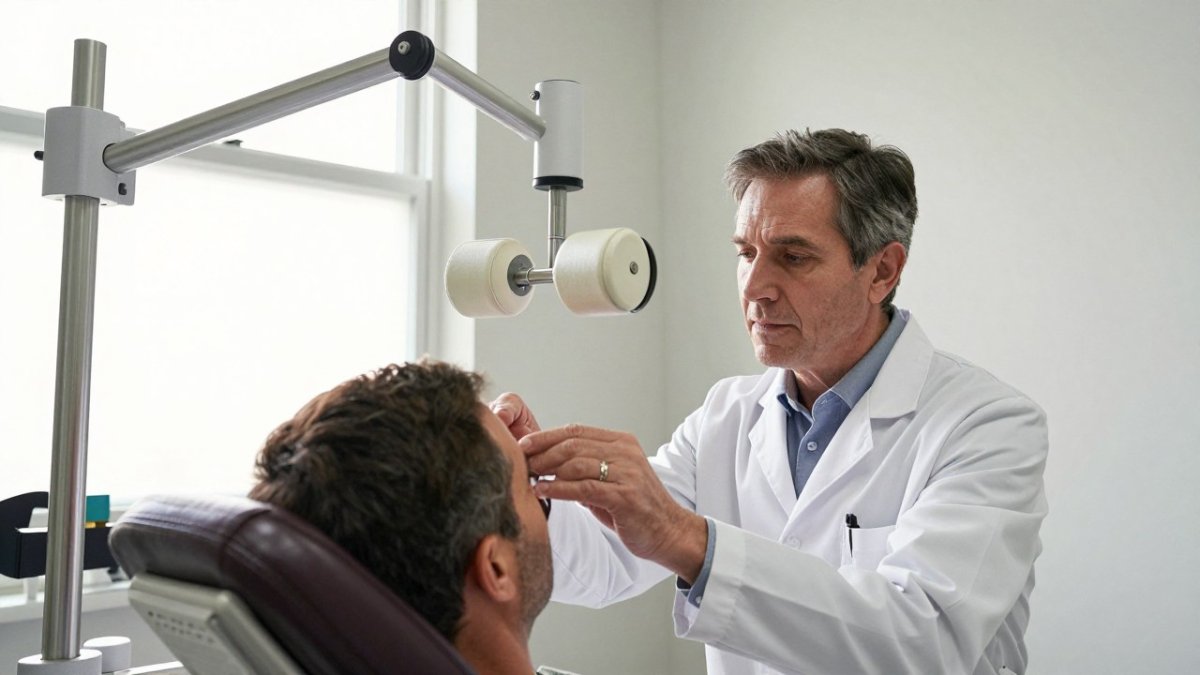
Get seated and fitted. You recline in a treatment chair. The coil is positioned against your scalp at your calibrated spot, and a headrest or positioning arm holds it steady so you don't have to.
Receive the pulses. You hear a series of sharp clicking sounds and feel a tapping or knocking sensation against your scalp. It is not painful for most people, but it is unmistakable. You stay awake and can read, watch something, or just rest.
Wrap up and go. No recovery period, no sedation. You can drive yourself home and return to your day.
Pro Tip Ask about scheduling your sessions in the early morning or late afternoon. Patients who lock in a consistent time slot report it's far easier to keep the five-day rhythm than those who book around whatever's open.
Watch Out If a session ever feels genuinely painful rather than just intense, say so during the session, not after. The dose and coil position can be adjusted, and there's no reason to white-knuckle through a treatment that's supposed to help.
Is TMS Covered by Insurance? Financial Navigation and Appeals
TMS is covered by many insurance plans when you meet medical necessity criteria, but coverage is not automatic and denials are common. The work usually falls on you and your provider to document the case properly.
Request the specific denial reason in writing
Ask your provider for a letter of medical necessity
Submit your full medication trial history with dates and dosages
File the appeal within your plan's stated deadline
Ask whether a peer-to-peer review between your doctor and the insurer's reviewer is available
TMS vs. Antidepressant Medication: A Comparison
TMS and antidepressant medication treat depression through completely different mechanisms, and that's why they aren't really competitors. Medication alters brain chemistry systemically. TMS stimulates specific neural pathways with magnetic fields.
Factor | TMS | Antidepressant Medication |
Mechanism | Magnetic stimulation of the prefrontal cortex | Systemic chemical adjustment |
Invasiveness | Non-invasive, no anesthesia | Pill-based |
Typical side effects | Scalp discomfort, headache | Weight, sleep, sexual, mood changes |
Onset of effect | Weeks into the protocol | Several weeks |
Best for | Medication non-responders | First-line treatment |
Watch Out Don't stop an antidepressant on your own to "make room" for TMS. Any medication change should be managed by your prescribing physician, because abrupt stops can trigger withdrawal symptoms and worsen depression.
TMS for Comorbid Conditions: Anxiety, OCD, and PTSD
TMS is FDA-approved for major depressive disorder and obsessive-compulsive disorder, and it's increasingly used in patients who have more than one condition at once. That overlap is the rule, not the exception.
Post-Treatment Lifestyle Integration and Relapse Prevention
Finishing a TMS course is a milestone, not a finish line. The weeks after treatment are when the habits you build determine whether the gains hold.
Keep a consistent sleep and wake time
Stay active, even in short daily bursts
Continue any talk therapy that's helping
Track mood patterns so you notice a slide early
Keep your follow-up appointments instead of skipping them once you feel fine
Key Takeaway The patients who hold their gains longest are usually the ones who treated recovery as an ongoing practice, not a completed task. Maintenance sessions plus steady lifestyle habits beat white-knuckling it alone.
Frequently Asked Questions
How effective is TMS for treatment-resistant depression?
Clinical trials show that about 50-60% of patients with treatment-resistant depression experience a significant reduction in symptoms after a full course of TMS, and roughly one-third achieve remission. Success rates are higher when TMS is combined with talk therapy and when patients complete the entire treatment protocol. Individual results vary based on factors like symptom severity, duration of depression, and adherence to the schedule.
What is the FDA-cleared protocol for TMS therapy?
The FDA cleared TMS for major depressive disorder in 2008. The standard protocol involves daily sessions (five days a week) for four to six weeks, typically totaling 20-30 sessions. Each session lasts 20-40 minutes. The protocol uses a magnetic coil placed on the scalp to stimulate the left prefrontal cortex, a region linked to mood regulation. Your physician will determine the exact parameters based on your condition.
What should patients expect during a typical TMS session?
You will sit in a comfortable chair while a technician positions the magnetic coil against your scalp. You will hear clicking sounds and feel a tapping sensation on your head. Most patients read, watch TV, or relax during the session. You can drive yourself home afterward. The procedure is non-invasive and does not require anesthesia. Mild scalp discomfort or headache may occur initially but usually fades after the first week.
Is TMS covered by insurance for treatment-resistant depression?
Many insurance plans cover TMS for treatment-resistant depression when specific criteria are met, such as failure of at least two antidepressant medications. Coverage varies by plan. Newtown TMS works with insurance companies to help navigate benefits and appeals. Contact them for details regarding payment options.
What are the common side effects of TMS therapy?
The most common side effects are scalp discomfort or headache during or after treatment, which typically diminish after the first week. Some patients experience mild tingling or twitching of facial muscles. Serious side effects like seizures are rare (less than 0.1% of patients). TMS does not cause memory loss or weight gain, unlike some medications. Discuss any concerns with your physician.
How does TMS differ from other depression treatments?
TMS is non-invasive and does not require surgery or implantation. Unlike antidepressant medication, it does not cause systemic side effects like weight gain, sexual dysfunction, or drowsiness. Unlike electroconvulsive therapy (ECT), TMS does not require anesthesia and does not cause memory loss. It specifically targets brain regions involved in mood regulation while the patient remains awake and alert.
Call Newtown TMS for a free consultation


Comments